
 Open in ChatGPT
Is Claude Down Right Now? Live Status and Outage Tracker
How to verify Claude's current status, which Anthropic services can fail on their own, and what to do while you wait for it to come back.
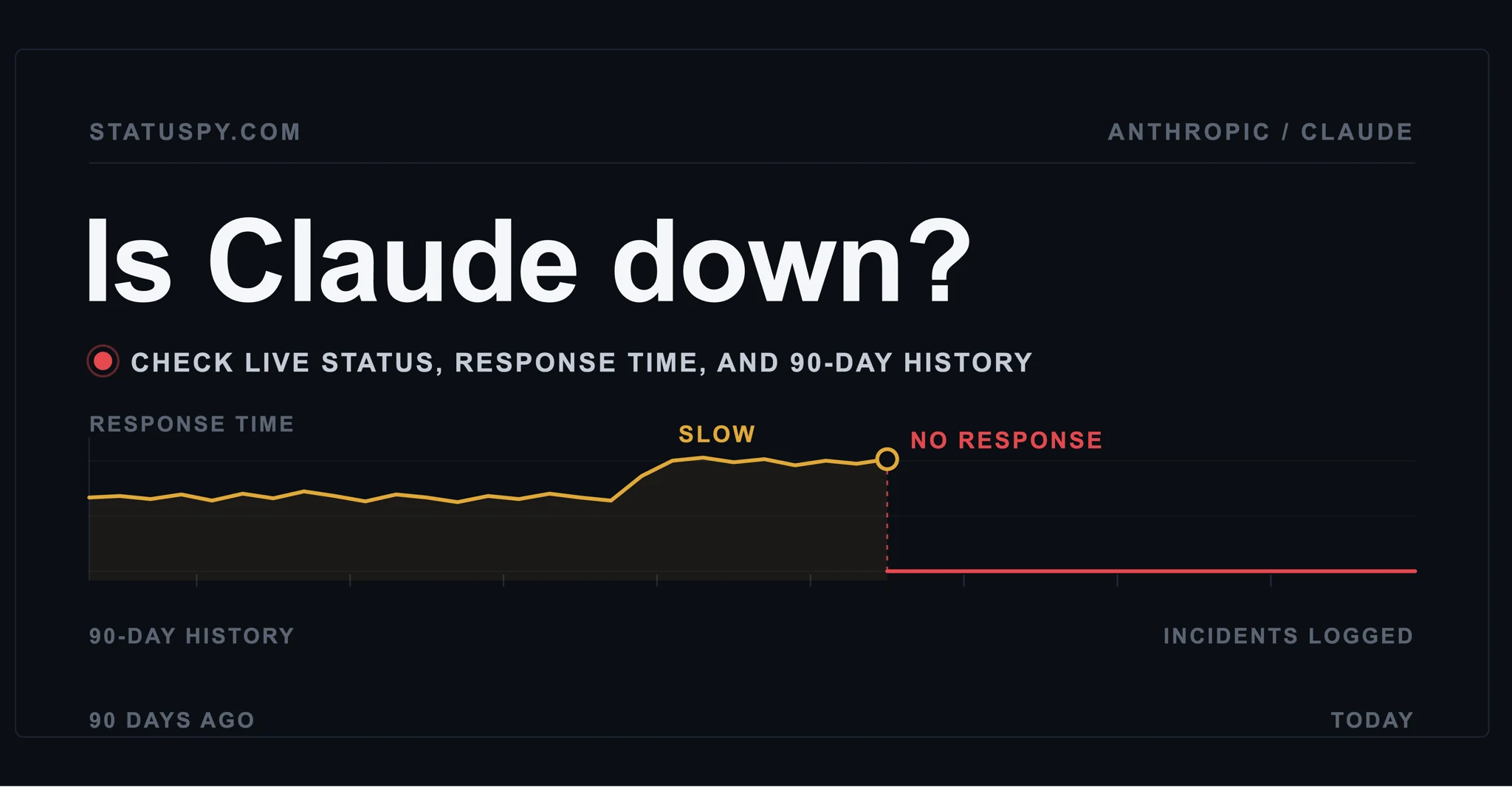
Claude stopped responding mid-conversation, and now you're staring at a loading spinner wondering if the problem is Anthropic's servers or your WiFi. That question has a concrete answer, but finding it requires checking the right sources in the right order.
This guide covers how to verify Claude's current status, which of Anthropic's services might be affected, and what to do while you wait for things to come back online.
Is Claude down right now#
The answer depends on which Claude service you're trying to reach. Anthropic runs several distinct systems under the Claude name, and one can go down while the others keep working. So when you ask "is Claude down," the first question back is: which part?
The quickest way to find out is to check an independent monitor that tests Claude from outside Anthropic's own network. Statuspy checks Claude every five minutes and shows the result with a timestamp. If the reading says "up," that means one HTTP request succeeded in under five seconds. If it says "down," three consecutive checks failed, which rules out a random dropped connection.
You might be wondering why three failures matter. A single failed check can happen for all sorts of reasons that have nothing to do with an actual outage. Waiting for three in a row gives you a much more reliable signal.
Which Claude services are affected#
Anthropic's products share a name but run on partially separate infrastructure. Understanding which piece you're using helps you figure out where the problem actually lives.
Claude.ai web app#
This is the browser-based chat interface at claude.ai, and it's what most people mean when they say "Claude." If you're typing prompts into a chat window, you're using the web app.
Claude API#
The API is the programmatic endpoint that developers call from their own code. Think of it as a behind-the-scenes connection rather than a visual interface. The API runs on different infrastructure from the web app, so developers can hit errors while regular chat users see nothing wrong. The reverse happens too.
Claude Code#
Claude Code is Anthropic's coding tool for terminal and IDE use. It connects to Claude's backend but has its own access layer, which means availability can differ slightly from the main chat interface.
Anthropic Console#
The Console at console.anthropic.com is where developers manage API keys, check usage, and handle billing. A Console outage can lock you out of account management even when Claude itself responds normally. If you can chat with Claude but can't generate a new API key, the Console is likely the culprit.
Claude mobile apps#
The iOS and Android apps connect to the same backend as the web app. However, app-specific bugs or outdated versions can cause errors that have nothing to do with Claude's servers. If the mobile app fails but the website works, try updating the app first.
What the official Anthropic status page says#
Anthropic publishes live status at status.anthropic.com. The page shows current operational state, active incidents, and scheduled maintenance windows.
Here's the catch: official status pages sometimes lag behind real-world problems. Anthropic's internal monitoring may not catch every issue immediately, especially regional failures or problems that affect only some users. You might see a green "operational" badge while Claude refuses to load for you.
That's why cross-referencing with an independent monitor helps. Statuspy checks Claude from outside Anthropic's network and compares findings against the official page. When the two disagree, you get a clearer picture of what's actually happening.
How Statuspy measures whether Claude is down#
Statuspy sends one unauthenticated HTTP request to Claude's endpoint every five minutes from its own servers. The check records the status code and how long the response took, then reports exactly what that proves.
- Up: One request from one machine succeeded in under five seconds
- Slow: The request succeeded but took longer than expected
- Down: Three consecutive checks failed
- Unverifiable: Could not get a usable reading, often because the service blocks automated requests
The three-failure threshold exists for a reason. A single dropped request can happen because of network hiccups, routing issues, or momentary server load. Declaring an outage based on one failure would create false alarms. Waiting for three consecutive failures filters out the noise.
When Statuspy can't get a clean reading, it says "unverifiable" rather than guessing. A service that blocks automated requests is never reported as down, because blocking isn't the same as failing.
Recent Claude outages and incidents#
Claude has experienced outages since its public launch, though frequency and severity vary. The table below shows incidents tracked by Statuspy. If you're reading this during an active incident, check the live status page for the latest updates.
| Date | Duration | Services affected | Severity |
|---|---|---|---|
| Aug 17, 2026 | 1h 33m | Degraded performance for Claude Opus 5, Claude Sonnet 5 | Degraded |
| Aug 16, 2026 | 36m | Service disruption on Claude services | Down |
| Aug 14, 2026 | 30m | Elevated errors for Claude Fable 5 | Down |
| Aug 14, 2026 | 1h 28m | Service disruption on Claude services | Down |
| Aug 14, 2026 | 15m | Service disruption on Claude Code on the web and related services | Degraded |
| Aug 13, 2026 | 1h 35m | Elevated errors for Claude Mythos 5, Claude Fable 5, and Claude Sonnet 5 | Down |
| Aug 12, 2026 | 4h 17m | Degraded performance for multiple models | Degraded |
| Aug 5, 2026 | 43m | Degraded performance for Claude Opus 5 | Degraded |
Statuspy records each incident with start time, duration, and which services were affected. Over time, this history reveals patterns, like whether outages cluster around certain times or affect specific services more than others.
Claude response time and uptime history#
Uptime percentage tells you how often Claude was reachable over a given period. Response time measures how quickly Claude's servers acknowledged a request, which is different from how long Claude takes to generate an answer.
To put uptime in perspective: 99.9% uptime sounds impressive, but it still allows for roughly 8.7 hours of downtime per year. The number matters most when you compare it across time periods or against other services.
Statuspy displays both metrics on the Claude status page with daily traces. The data comes from Statuspy's own checks, not from Anthropic's self-reported numbers. That distinction matters because vendors sometimes measure uptime differently than users experience it.
How to tell if Claude is down or if it is just you#
When Claude stops responding, the problem might be on Anthropic's end, on your end, or somewhere in between. Working through a few steps in order usually gives you an answer within minutes.
1. Check an independent monitor first#
Start with a third-party status tracker like Statuspy. If the monitor shows Claude as "up" with a recent timestamp, the problem is likely on your side. If it shows "down," you've confirmed a broader outage and can stop troubleshooting your own setup.
This step comes first because it's the fastest way to rule out a global problem. No point clearing cookies if Claude is down for everyone.
2. Cross-reference the Anthropic status page#
Next, go to status.anthropic.com to see whether Anthropic has acknowledged an incident. Keep in mind that official pages sometimes update slowly. A green status doesn't guarantee everything works, but an active incident notice confirms the problem isn't just you.
3. Test Claude from a different network#
Try switching from WiFi to mobile data, or connect to a different WiFi network entirely. This isolates whether your ISP or local network is blocking or throttling the connection.
If you use a VPN, try disconnecting. Some VPN exit nodes get flagged and blocked by services, which creates errors that look like outages but aren't.
4. Clear cookies and sign in again#
Stale session tokens can cause errors that look like outages. Clear your browser cookies for claude.ai, close the tab, and sign in fresh. This fixes a surprising number of "Claude is broken" reports, especially if you've been logged in for a while.
5. Check your API key and rate limits#
If you're a developer hitting the API, verify that your key is still valid in the Console. Check whether you've exceeded your usage limits or whether your billing method has expired.
Rate limits cap how many requests you can send in a given time window. Hitting them returns errors that can look like downtime, but the fix is waiting or upgrading your plan rather than troubleshooting Claude itself.
What to do while Claude is down#
Once you've confirmed Claude is actually down, a few steps can save you time and frustration while you wait.
1. Save your prompt and wait for a retry window#
Copy any unsent prompts to a text file. Most Claude outages resolve within an hour or so. Refreshing the page repeatedly doesn't speed up recovery and can make things worse if the servers are already overloaded.
2. Watch for Anthropic incident updates#
Bookmark status.anthropic.com or follow Anthropic's social channels. Incident updates typically include estimated resolution times and which services are affected. Knowing the timeline helps you decide whether to wait or switch to something else.
3. Switch to a backup model for time-sensitive work#
If your work can't wait, use an alternative AI assistant temporarily. The next section covers a few options.
4. Report the issue to Anthropic support#
If you experience a problem that isn't reflected on the status page, report it through Anthropic's support channels. Include the exact error message, timestamp, and which service you were using. User reports sometimes surface issues that internal monitoring misses.
Alternatives to use while Claude is down#
When Claude is unavailable and you have time-sensitive work, other AI assistants can fill the gap.
ChatGPT#
OpenAI's assistant at chat.openai.com. Available via web, mobile apps, and API. It's the most widely used alternative and handles similar tasks.
Google Gemini#
Google's AI assistant at gemini.google.com. Integrates with Google Workspace tools like Docs and Gmail, which is useful if you're already in that ecosystem.
Microsoft Copilot#
Microsoft's assistant at copilot.microsoft.com. Uses OpenAI models with Bing search integration, so it can pull in current web information.
Perplexity#
AI search assistant at perplexity.ai. Focuses on sourced answers with citations, which makes it useful for research-oriented queries.
Frequently asked questions about Claude outages#
Check Claude status live on Statuspy#
Statuspy checks Claude every five minutes from independent servers and reports exactly what each check proves. The status page shows current state, response time, uptime percentage, and recent incidents, all with timestamps so you know how fresh the data is.

 X
X LinkedIn
 Reddit